


This week’s podcast is taken from a recent webinar about COPD delivered by Nicola Wood. Nicola is an Advanced Nurse Practitioner who works with the Primary Care Respiratory Society on their executive and policy panels. Before moving into Primary Care, she was a Respiratory Specialist Nurse. In her webinar, she talks about what to cover in a COPD review and understanding National and International COPD guidance. She reinforces the learning using case studies. This podcast includes some key points from Nicola’s webinar. To learn more, sign up for one of our COPD sessions on the Training for Pharmacists page of our website.
What is COPD?
We should be making sure that patients know and understand what COPD is. The acronym stands for:
- Chronic (long term)
- Obstructive (the air flow is slowed down or obstructed)
- Pulmonary (lungs)
- Disease (collection of symptoms)
Respiratory Red Flags
Did you know that people with COPD are 25% more likely than the rest of the population to develop lung cancer? Unfortunately, we are more likely to miss the symptoms because they often mirror the symptoms of COPD. This list explains what to look for as signs of lung cancer. You will recognise many of them as part and parcel of COPD.
- Frequent or unresolving chest infections
- Hemoptysis
- Weight loss
- Chest pain
- Fatigue
- Shortness of breath
- Persistent cough
Another thing to look out for is finger clubbing. This can indicate serious cardio or respiratory disease, but you won’t know the cause just from seeing it. Finger clubbing is a change to the angle of the nail bed. It is quick and easy to check for by getting the patient to put their index fingers together. If you can see a diamond of light coming through at the base of the nail, that is normal. When that light disappears, the angle of the nail bed has changed. This can be a cancer sign and should always be investigated.
COPD and chest x-rays
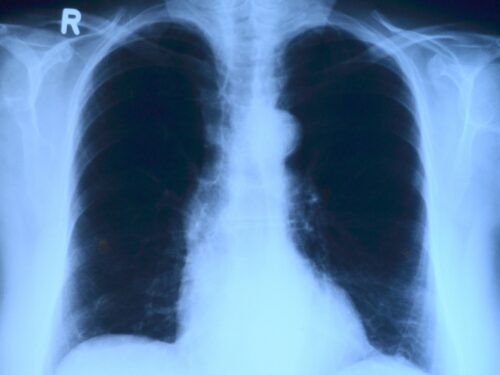
It is not appropriate to diagnose COPD based on a chest x-ray because it is characterised by obstruction of air flow. It is not possible to see air flow on a chest x-ray. However, it can be useful when new respiratory symptoms materialise. If you are reviewing COPD, whoever started the investigations will have requested a chest x-ray to make sure we are not missing anything. If there is no chest x-ray on their file, it is important to get one done. If any of the lung cancer symptoms are present but the x-ray is clear, bear in mind that not all lung cancer can be detected by a chest x-ray. About 20-25% of cases are missed on the x-ray. So, you can still refer on a suspected lung cancer case even with a clear chest x-ray.
NICE guidelines: Things to consider before starting inhaled therapies
Once a COPD diagnosis is confirmed, there are certain steps you need to take prior to starting inhaled therapies.
NICE guidelines outline the fundamentals of COPD care:
- Offer treatment and support to stop smoking
- Offer pneumococcal and influenza vaccines
- Offer pulmonary rehabilitation if indicated
- Co-develop a personalised self-management plan
- Optimise treatment for comorbidities
These treatments and plans should be revisited at every review.
Only start inhaled therapies if:
- All above interventions have been offered (where appropriate) and
- Inhaled therapies are needed to relieve breathlessness and exercise limitation, and
- People have been trained to use inhalers and can demonstrate satisfactory technique
Medication should be reviewed and inhaler technique and adherence assessed regularly for all inhaled therapies.
How do we check for a confirmed diagnosis of COPD?
To check for a confirmed diagnosis of COPD, we need to look at the following:
- Risk factors: If a patient is presenting with symptoms indicative of COPD with no risk factors, it is not likely to be COPD. Risk factors may be occupational, including working with textiles, small particles or chemicals such as chlorine. Miners and bakers may also have occupational risk factors. If there is no occupational history but they have 20 pack years of smoking history, this is enough to do significant damage. One pack year is 20 cigarettes a day for a year. The idea with pack years is to standardise risk because everyone smokes different amounts. This can be checked on the pack years calculator. You also need to consider whether they have been smoking drugs or shisha pipes. If there are no risk factors, we may not be looking at COPD.
- Spirometry: Post-bronchodilator spirometry is a confirming test for COPD. The patient’s symptoms should be controlled and they need post-bronchodilator spirometry so the airways are as open as they can be on inhaled therapies. If their lung function is still abnormal and they’re not managing to clear 70% of the volume in their lungs in one second, it is slowed down and therefore obstructed. This would confirm COPD.
- Symptoms: If a person has no symptoms then we would not diagnose the disease even if they have risk factors and spirometry in the lower levels.
In her COPD webinar, Nicola looks at each of these areas in some detail. She runs through the fundamentals of COPD care, explaining which is the most impactive and why. The relative impact and expense is also covered.
Inhaler algorithms guidance from NICE and GOLD
Once diagnosis is confirmed, we need to look at either NICE or GOLD guidelines for treating COPD. Each offers a different approach and provides a flow chart to support the route you need to take. In her COPD webinar, Nicola goes into significant detail about both pathways. She also talks through the Primary Care Respiratory Society (PCRS) pragmatic guidance for crisis management of asthma and COPD during the Covid-19 pandemic.
Nicola goes on to look at the considerations when choosing an inhaler device, including using low carbon inhalers due to concerns around carbon footprint. She also looks at when to refer patients on, as well as other topics. All the learning is further cemented using case studies. If you would like to learn more on the topic, head to the MORPh Training for Pharmacists page to find a relevant webinar for your area.